Decoding Your Anxiety: How the COMT Gene Affects Stress
Science shows that over 20% of people are born with a “Worrier” brain type. This means their minds actually clear out stress chemicals up to 40% slower than others. Learning exactly how the COMT gene affects stress can completely change your approach to anxiety. Therefore, knowing your specific genetic code stops the daily guessing game. Let’s uncover the secret biology behind your biggest worries.
Quick Answer: How does the COMT gene affect stress?
The COMT gene controls how fast your brain clears out stress chemicals like dopamine and adrenaline. A simple DNA test can reveal if you have a fast “Warrior” or a slow “Worrier” COMT variant. Knowing your specific genetic type gives you personalized, actionable steps for managing anxiety, improving focus, and optimizing your mental health.
The COMT gene (Catechol-O-Methyltransferase) produces an enzyme responsible for clearing excess stress hormones and dopamine from your brain. These include key neurotransmitters like dopamine, norepinephrine, and epinephrine.
Think of the COMT enzyme as a brain cleanup crew. After dopamine fires, the enzyme clears it away so the nervous system can reset.
Proper COMT gene dopamine regulation is essential for maintaining emotional balance. This process becomes highly personalized based on your specific variants of this gene.
The Val158Met Polymorphism — A Genetic Stress Switch
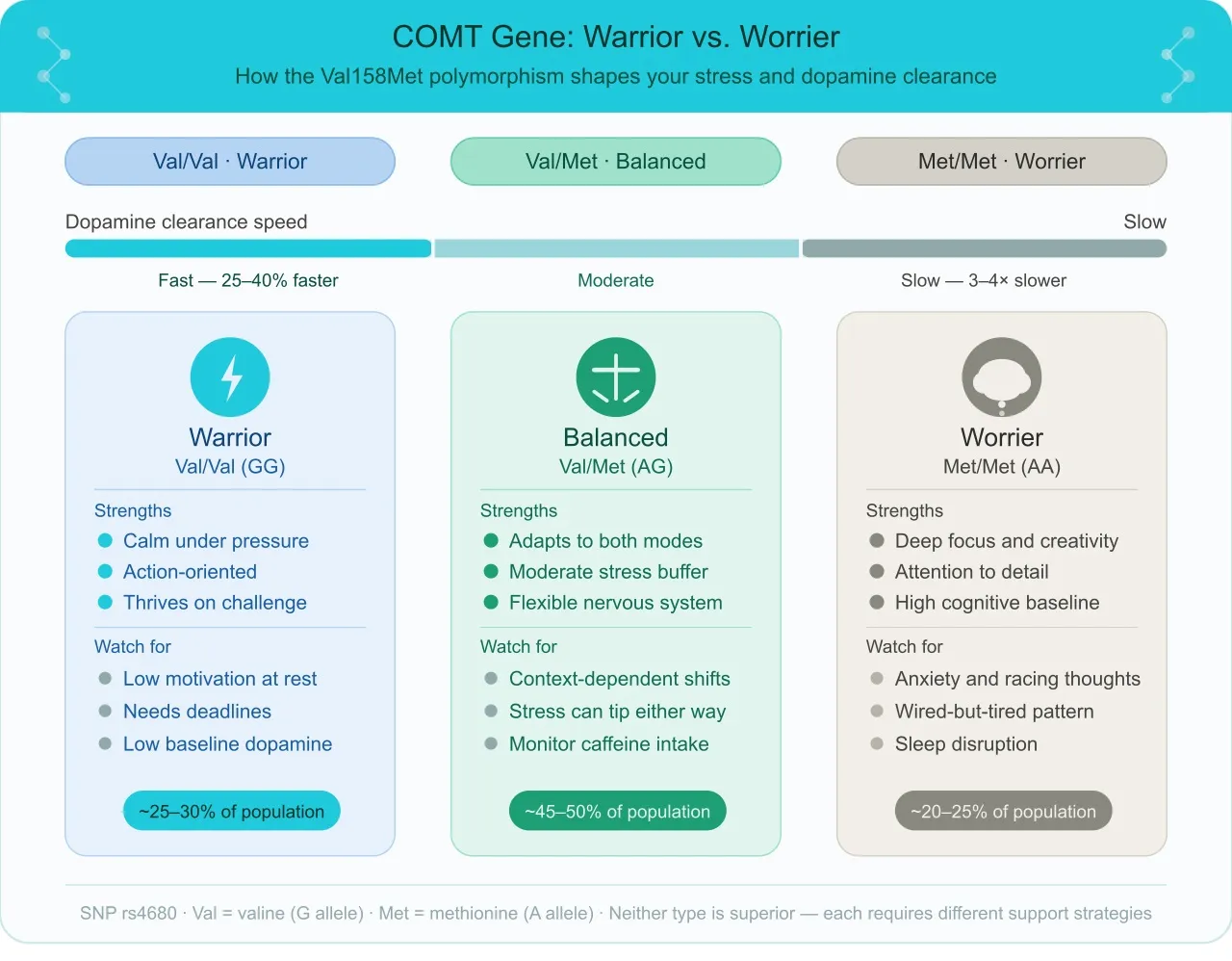
The most studied variant is the COMT Val158Met polymorphism (rs4680), which has a strong link to anxiety.” This is a single change in DNA, a swap of one amino acid at position 158. This swap dramatically changes how efficiently the body clears dopamine.
Val/Val- GG (Warriors): Fast enzyme activity. Dopamine clears quickly. These individuals tend to stay calm under pressure but may have lower baseline motivation in low-stimulation environments.
Met/Met- AA (Worriers): Slow enzyme activity. Dopamine and stress hormones linger longer. They possess strong focus and creativity at rest, but show high susceptibility to overwhelm under pressure.
Val/Met– AG (Balanced): Moderate enzyme activity. This is a middle-ground response that adapts well across different stress environments.
How exactly does this translate to real-life anxiety? The answer lies in dopamine regulation within the prefrontal cortex (PFC).
Understanding the COMT Gene Stress Response
Science shows that the COMT gene stress response is about more than just feeling nervous. It causes real changes we can measure in both your body and your brain:
Clear Signs in Your DNA: Scientists use these gene types as trusted genetic markers for anxiety, pain, and how easily you get stressed out.
Stronger Physical Reactions: In scientific stress tests, people with the “Worrier” gene type have a much stronger physical and chemical reaction to pressure than “Warriors” do.
Changes in Brain Chemistry: The COMT stress gene variant actually slows down the helpful enzymes in the amygdala.
Higher Health Risks: Because of these inner brain changes, people might face a higher risk for panic attacks or depression. This clearly shows how genetics affects stress right down to our cells.
Recognizing COMT Anxiety Symptoms and Genetics
Depending on the genotype, COMT gene personality traits and symptoms present very differently in daily life.
Slow COMT (Met/Met — Worrier) symptoms often include:
Racing thoughts, especially under high pressure.
Difficulty winding down after a stressful day.
Heightened sensitivity to noise, crowds, or conflict.
Feeling “wired but tired”, exhausted but unable to switch off at night.
Fast COMT (Val/Val — Warrior) symptoms often include:
Low motivation or mental flatness in calm environments.
Difficulty sustaining focus on routine, everyday tasks.
A constant need for high-stakes deadlines to feel engaged.
Risk of low mood without adequate external stimulation.
COMT and Broader Anxiety Spectrum Risk
Research shows that the COMT gene affects much more than just everyday, short-term stress:
Shared Anxiety Risks: Large studies on twins show that these genetic variants increase the risk for many different kinds of anxiety conditions.
Wider Mental Health Impact: Your genetic data can influence a whole spectrum of mental health challenges over your lifetime.
Weaker Calming System: Clinical studies link these variants to a weaker resting “calming system” in your body (your parasympathetic nervous system).
Risk for Chronic Anxiety: This weakened calming system is directly tied to a higher risk for Generalized Anxiety Disorder (GAD).
COMT and the Broader Anxiety Spectrum
Research shows that the COMT gene plays a role in more than just everyday, short-term stress:
Shared Anxiety Risks: Large studies suggest that certain COMT variants may be associated with a higher sensitivity to stress, which can contribute to a range of anxiety-related tendencies.
Wider Mental Health Influence: These genetic patterns can influence how your brain processes emotions, focus, and stress over time — but they are just one piece of a much bigger picture that includes lifestyle and environment.
Calming System Response: Some variants have been linked to differences in the body’s “rest and recovery” system (the parasympathetic nervous system), which may affect how easily you return to a calm state after stress.
Potential for Ongoing Stress Patterns: When this calming response is less efficient, it may contribute to a tendency toward more persistent or chronic stress if not well supported.
Important to Know
These findings reflect tendencies, not outcomes – they do not mean you will develop an anxiety disorder.
Many individuals with these variants also show strengths such as deep thinking, emotional awareness, and strong cognitive performance.
Lifestyle factors, including sleep, nutrition, stress management, and physical activity, play a major role in how these genetic tendencies are expressed.
Yes, a DNA test for stress predisposition can reveal your genetic dimension of anxiety, providing practical, actionable steps for your mental health. Knowing that anxiety has a genetic dimension is powerful. However, it is only useful if actionable steps can be taken.
Anxiety is rarely random. For many people, it is woven directly into their biology. Understanding the mechanics behind this biological reality removes the guesswork and the shame. It provides the necessary data to stop fighting the nervous system and start working with it.
By learning about epigenetics and gene expression, individuals can use targeted lifestyle changes to optimize their mental health. Whether someone is a Warrior, a Worrier, or somewhere in between, utilizing a comprehensive genetic test provides the clarity needed to make smarter, data-driven choices for mental health, sleep, and daily energy.
This content is intended for educational and informational purposes only. While we strive to provide accurate, science-based insights, we are not medical professionals, and this article is not a substitute for personalized medical advice. Always consult your healthcare provider regarding questions about your health.
Author Bio
Dr. Lois Nahirney founded dnaPower after a personal family health journey. She is dedicated to making the science of genetics simple and actionable. Her mission is to empower everyone with the knowledge to control their well-being.
Don't Want to Miss Anything?
Get weekly updates on the newest DNA stories, case studies and tips right in your mailbox.