

We all have that one friend. It’s 9:30 PM at a restaurant. They order a double espresso, drink it, go home, and immediately sleep for eight uninterrupted hours like a peaceful, well-adjusted newborn.
Meanwhile, if you so much as glance at a coffee bean past 1:00 PM, you find yourself staring at your bedroom ceiling at 3:00 AM, calculating how many hours of life you have left if you never sleep again.
It feels unfair. It feels like a personal failure. But it isn’t. It’s just mechanics. Specifically, it’s your liver operating on a completely different genetic blueprint than your late-night-espresso-drinking friend.
When you drink a cup of coffee, the caffeine doesn’t magically disappear when the buzz wears off. Your body treats caffeine like a low-level chemical intruder that needs to be scrubbed from your system.
The heavy lifting is done by an enzyme in your liver called CYP1A2 (encoded by the CYP1A2 gene). How fast that enzyme works depends entirely on which version of the CYP1A2 gene you inherited:
Fast Metabolizers carry the 1F/1F genetic variant. Their liver works at hyper-speed, clearing half the caffeine in their system in a couple of hours. They can chug an iced latte with lunch and be biologically cleared for sleep by bedtime.
Slow Metabolizers carry the 1A/1F or 1F/1F variants associated with lower enzyme activity. Their caffeine-processing enzyme works at a remarkably slow pace, allowing caffeine to linger in the body for hours longer than expected. That 3:00 PM cold brew may still be actively circulating through their system when they are trying to wind down for bed.
While your liver dictates how long caffeine stays at the party, a second gene determines how chaotic the party gets while it’s happening.
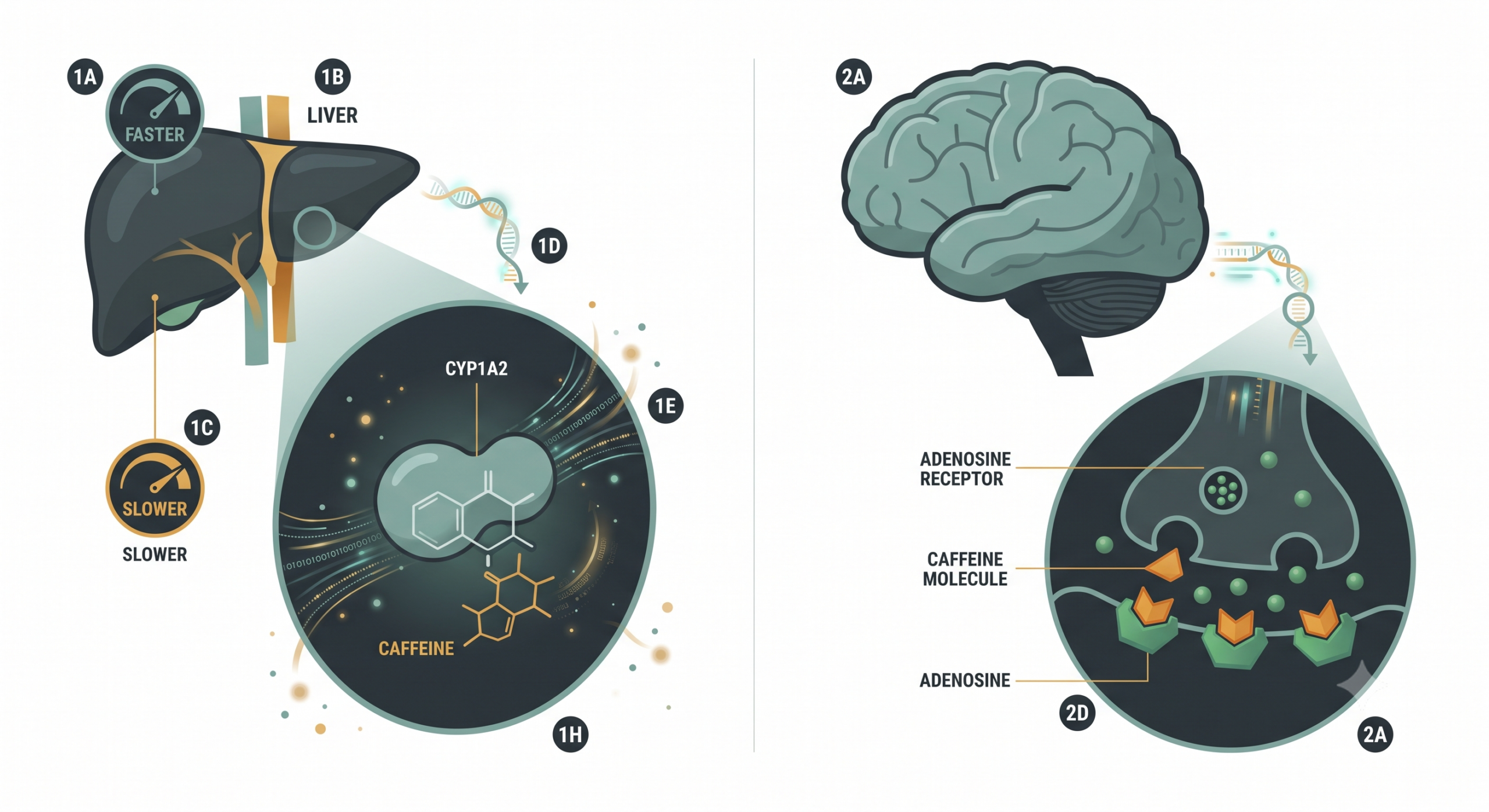
Meet ADORA2A. This gene builds the adenosine receptors in your brain.
Normally, adenosine builds up in your brain, plugging into these slots to make you feel beautiful, heavy sleepiness. Caffeine’s entire trick is that it looks exactly like adenosine; it sneaks into those slots, blocks the real sleep molecules, and tricks your brain into thinking you are a vibrant, high-energy biological machine. If your ADORA2A gene builds highly sensitive receptors, caffeine doesn’t just wake you up, it sends your nervous system into a localized panic state.
Because your DNA doesn’t change, your tolerance isn’t something you can “train” at the gym.
For Fast Metabolizers, the biological reality is they clear caffeine at lightning speed. They have less risk of cardiovascular strain from high doses. Your Hard Curfew: 3:00 PM.
For Slow Metabolizers, the reality is caffeine lingers in their bloodstream for 10+ hours. High doses can spike blood pressure and ruin deep sleep. Your Hard Curfew: 11:00 AM. Switching to decaf isn’t a defeat—it’s tactical resource management for your deep sleep architecture.
If your DNA report says you have the CYP1A2 “Fast Metabolizer” gene, you might think you have a free pass to drink coffee forever with zero consequences. But biology loves a team-up. To see the absolute full picture of how you process your morning cup, you have to look at a second, highly vocal ecosystem inside your body: your gut microbiome.
While your human DNA acts as your fixed, unchanging master blueprint, your gut bacteria act like an unstable software update that changes based on what you eat. When you combine a DNA test with a gut microbiome sequence (like MapmyBiome), you finally unlock the full 3D view of your health.
Coffee has a remarkable prebiotic-like effect on the gut microbiome. Regular coffee consumption has been strongly associated with higher levels of the butyrate-producing bacterium Lawsonibacter asaccharolyticus—affectionately dubbed “the coffee bug.” As this microbe metabolizes coffee-derived compounds, it produces butyrate, a short-chain fatty acid that helps maintain the intestinal lining, lowers brain inflammation, and may influence communication along the gut-brain axis.
Combined data saves the day. Studies show that beneficial bugs bloom just as happily on decaffeinated coffee.
Your DNA tells you: “Stop drinking caffeine past 11:00 AM.“
Your Microbiome tells you: “Keep feeding us coffee polyphenols!“
Your Custom Strategy: Seamlessly switch to a high-quality Swiss-water decaf at noon. Your brain gets to sleep, your liver gets a break, and your gut microbes get their favourite lunch. A DNA lifestyle test cuts out the guessing game.
For most adults, caffeine has an average half-life of 3 to 7 hours, but genetics can shift that dramatically. Fast metabolizers clear caffeine much more quickly, while slow metabolizers may still have substantial amounts circulating 8–12 hours after their last cup.
Not at all. It simply means your body processes caffeine more slowly. Many slow metabolizers feel the effects of smaller amounts of caffeine for longer periods, so they often benefit from drinking coffee earlier in the day or choosing decaf in the afternoon.
You can develop tolerance to some of caffeine’s stimulating effects, but you can’t train your liver to change your CYP1A2 genetics. If you’re genetically a slow metabolizer, caffeine will still remain in your bloodstream longer than it does for a fast metabolizer.
Yes. Many of coffee’s beneficial compounds are polyphenols, not caffeine. Research suggests that both regular and decaffeinated coffee can promote beneficial gut bacteria, including Lawsonibacter asaccharolyticus, making decaf an excellent option for people who want the microbiome benefits without disrupting sleep.
Your ADORA2A gene influences how sensitive your brain’s adenosine receptors are to caffeine. People with certain variants may experience stronger effects, including jitters, nervousness, or anxiety, even after relatively small amounts of caffeine.
Not necessarily. Many slow metabolizers do well by limiting caffeine to the morning and switching to decaf after lunch. The goal isn’t to eliminate coffee—it’s to match your coffee habits to your biology.
Coffee contains hundreds of bioactive compounds beyond caffeine, including antioxidants and polyphenols that may benefit the gut microbiome and overall health. If caffeine interferes with your sleep, switching to decaf later in the day can help you retain many of coffee’s potential benefits while minimizing the downsides of prolonged caffeine exposure.
If you’re a slow caffeine metabolizer, the goal isn’t to give up coffee—it’s to reduce caffeine while keeping coffee’s beneficial plant compounds.
The Swiss Water Process removes about 99.9% of the caffeine using only water, temperature, and time, without chemical solvents. Because the coffee beans still contain their naturally occurring polyphenols and other bioactive compounds, Swiss Water decaf can continue to nourish beneficial gut microbes, including Lawsonibacter asaccharolyticus, while dramatically reducing the risk that caffeine will interfere with your sleep.
In other words, it’s the best of both worlds: your brain gets a break from caffeine, while your gut microbes can still enjoy many of coffee’s health-promoting compounds.